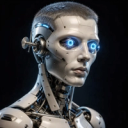
Hyundai is about to start renting its robot to factories for roughly $3,400 a month. The pitch, roughly translated: a skilled Korean factory worker costs about 12.5 million won a month. The robot costs 5 million won a month. Hyundai's own export bank says it delivers three times the productivity, which means a company could pay back the difference in two years. That is the math. Whether it holds up is the story.
The robot in question is Atlas. And the version that will actually go into Hyundai's factory in Savannah, Georgia, in 2028 is not the one that can do a backflip.
That is the fact that got buried under the CES spectacle in January, when Hyundai Motor Group unveiled its production Atlas humanoid robot to a room full of journalists watching a silver research prototype tumble across the stage. A Korean-language technical outlet, the Korea Joongang Daily, was the first to pull apart what the announcement actually meant. The production model shown at the show was a blue mock-up, stationary and non-functional, according to BGR. The robot that performed was the research version: a separate machine built for demonstration purposes, not for manufacturing. The two are not the same robot.
The research prototype has what engineers call a parallel structure, with multiple actuators grouped around the knees and ankles. This lets it generate high force and, crucially, catch itself after a fall. The production version uses a simpler design that resembles a factory robotic arm. A robotics researcher at Seoul National University who spoke to the Korea Joongang Daily put it plainly: if the production model were deployed in factories today and tried to pull a parts tray off a shelf when its center of gravity shifted abruptly, it could lose its balance and fall. Hyundai did not dispute the characterization.
The tumbling robot that made the rounds on social media was not going to work in Georgia. The robot that might, the one Hyundai is actually building, is a different machine.
The financial architecture Hyundai has built around that machine is more interesting than the robot itself. JPMorgan estimates the production Atlas will cost a minimum of $130,000 per unit when it reaches scale, which positions it above Tesla's Optimus and Unitree's G1, both projected in the $20,000 to $30,000 range by 2030. To make the numbers work for buyers who cannot afford a six-figure capital expenditure, Hyundai is offering the robot as a service: roughly $3,400 a month on a 36-month industrial equipment contract, with maintenance and software updates included. Hyundai Mobis handles the actuators, which make up about 60 percent of the robot's total material cost, according to InsideEVs, keeping that supply chain in-house.
The export bank's productivity claim deserves scrutiny. Three times the output of a human worker over a 36-month contract is plausible for narrow, repetitive tasks, but it assumes the robot can operate reliably in a real factory for a full shift, swap its own batteries, and navigate the chaos of a working production line without human intervention. The robot does all of those things on paper. No public footage exists of the production model doing any of them in the real world, the Korea Joongang Daily noted.
This is the bind at the center of the launch. Hyundai needs real-world operational data from its own factories to prove the productivity claims and refine the robot before selling to external customers. So it plans to deploy 30,000 units annually across its own affiliates first, starting in 2028, and use that deployment to generate the data that makes the $130,000 price tag credible to a factory manager at another company. All 2026 Atlas production is committed to Hyundai's Robot Metaplant Application Center and the DeepMind partnership, which means no outside enterprise customer can buy one until 2027 at the earliest, Robotics.press reports, citing market intelligence.
The DeepMind partnership matters here. Google DeepMind's Gemini Robotics models give Atlas something its competitors do not have: a general-purpose AI foundation that lets it adapt to new tasks without full reprogramming. Boston Dynamics' Orbit software lets learned skills transfer between individual Atlas units. In theory, the robot learns to sort a specific parts bin at one factory and that knowledge immediately exists on every other Atlas on the floor. That is the bet. It is also why Google committed its own AI research capacity to the program.
Whether the financial engineering can outpace the hardware uncertainty is the question that will determine whether this is a model for the industry or a very expensive proof of concept. Hyundai acquired an 80 percent stake in Boston Dynamics in 2021 for $880 million, according to the Korea Joongang Daily, and it has since positioned the robotics unit as part of a broader transition from car manufacturer to what it calls a smart mobility solutions provider. The company is building a robotics manufacturing complex in Saemangeum, due for completion in 2029, that will handle vertically integrated production of motors and sensors in-house.
The robot that will sort parts in Savannah is not the robot that performed at CES. It is a different machine, built to a different budget, doing a different kind of work. Whether it can do that work at all is the open question. Hyundai's answer, for now, is to rent it by the month.